The Diverse Futures of Large Language Models Explored
by Jorge Vallego
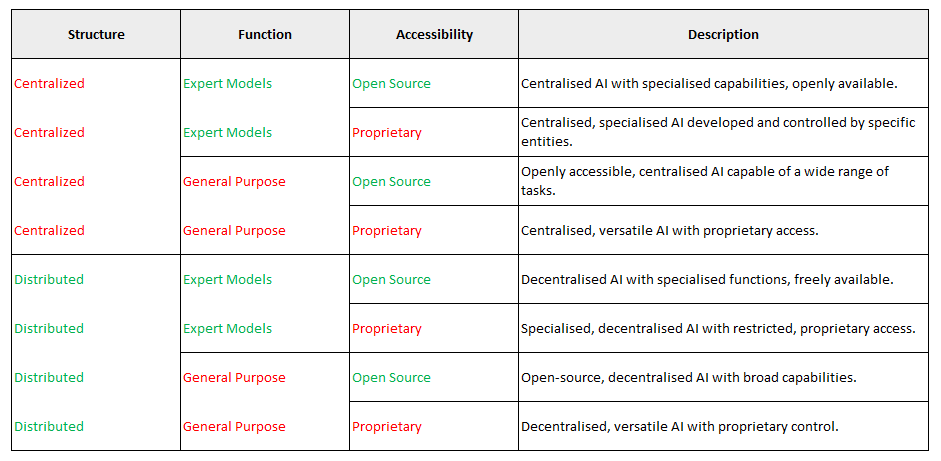
Exploring the future of artificial intelligence through its potential configurations reveals a complex landscape shaped by three critical dimensions: the structure of AI systems (centralised vs. distributed), their functional design (expert models vs. general purpose models), and their mode of distribution (open source vs. proprietary). These dimensions intersect to create eight distinct possibilities for AI’s evolution, each with unique implications for technology, society, and governance.
- Centralised Expert Models, Open Source
This scenario envisions specialised AI systems developed with a focus on specific tasks, centrally controlled but openly available for use and modification. It suggests a future where expertise is democratised, allowing widespread access to powerful tools while maintaining centralised oversight.
- Centralised Expert Models, Proprietary
Here, specialised AI remains under the tight control of its developers or corporations, with restricted access. It could stifle competition and innovation outside proprietary circles. This future could lead to significant concerns over monopolistic control and ethics.
- Centralised General Purpose Models, Open Source
General purpose AIs that can perform a wide range of tasks, developed centrally but distributed openly. It promises in AI accessibility, with versatile tools available to all, encouraging innovation and broad application.
- Centralised General Purpose Models, Proprietary
This vision involves versatile, centrally controlled AIs with restricted access, possibly leading to powerful monopolies that control the technology’s direction and use. This is probably the worst case scenario.
- Distributed Expert Models, Open Source
Specialised AIs developed across decentralised networks, freely accessible, epitomise this future. It suggests a collaborative, open approach to solving specific problems, enabling diverse contributions and reducing single points of failure or control.
- Distributed Expert Models, Proprietary
In this scenario, specialised AIs are developed in a decentralised manner but are proprietary. It could lead to a competitive landscape, raising questions about accessibility, ethics and governance and also complicating interoperability and integration.
- Distributed General Purpose Models, Open Source
Envisions an open, decentralised development of versatile AI systems. This future could democratise AI spreading its benefits widely but also raising questions about governance, security, and ethics in a decentralised framework.
- Distributed General Purpose Models, Proprietary
Finally, this possibility combines the broad capabilities of general-purpose AI with decentralised development and proprietary access. It would be a challenges in governance and equitable access.
The goals H4rmony Project address all these scenarios, directly or indirectly, to ensure that we will have the tools to turn around the ecologically damaging narratives. Given the project’s three main objectives—creating open-source, general-purpose LLMs fine-tuned on ecolinguistically curated datasets; developing context-aware chat assistants; and establishing an eco-awareness benchmark—the potential impact on the eight possible futures of AI can be profound and multifaceted, especially in open source scenarios. The eco-awareness benchmark and ecologically aligned chat assistant would play fundamental roles in setting standards and inspiring proprietary models.
 The H4rmony Project