Central to the H4rmony project is judging whether responses from AI are ecologically beneficial or destructive, with the aim of reducing destructive responses and promoting beneficial ones. It is therefore necessary to have robust and transparent criteria for judging statements against. In ecolinguistics, this involves an ecosophy, or ecological philosophy, which is an explicit statement of the values and goals of the analyst.
The H4rmony Project has adapted and adopted the ecosophy from the book Econarrative: ethics, ecology and the search for new narratives to live by (Stibbe, 2024, p.22) as an ecosophy common to the team. The overall focus of the ecosophy is on Living, as something to be celebrated, respected and preserved – all species living with high wellbeing now and into the future as far as possible. In more detail the ecosophy is as follows:
- Health and wellbeing: For all humans as well as the other beings and species we share the planet with.
- Ecological boundaries: Staying within ecological boundaries to ensure that health and wellbeing can continue into the future.
- Reduced consumption: Boundaries have already been exceeded so a massive quantitative reduction in overall consumption is necessary.
- Greater efficiency: More efficient and ecologically beneficial processes in agriculture, manufacturing, transport, housing, energy production and other key sectors are necessary in addition to reduced consumption.
- Social justice: Those in poverty must be able to increase consumption even as overall consumption levels decrease, which requires redistribution of wealth.
- Resilience: Some negative environmental changes have already occurred, and others are inevitable, so it is necessary to prepare for life on a less hospitable planet.
- Systemic change: The scale of these changes is so vast that deep social, political and cultural changes are essential.
These general statements are expanded into more detailed sub-statements in a live document that is updated based on the latest evidence. For example, ‘environmental boundaries’ is expanded into biodiversity, climate change, ocean acidification etc, aspects of wellbeing are listed, conflicts of interest are considered, beings beyond the level of species (e.g., forests and rivers as larger assemblies) are taken into account, as well as details of the kinds of systemic changes necessary to meet the scale of the challenge. While the live document, H4rmony Ecosophy in Depth, provides more details, it is not intended to be a fully comprehensive description of the ideal ecological civilisation, but just an indication of some of the directions unsustainable industrial civilisations need to travel.
It is recognised that the H4rmony ecosophy is just one possible ecosophy among many other valid ecosophies, and that different cultures have different ways of conceptualising ideal ecological relationships. However, it is necessary for the H4rmony team to work with one common ecosophy to ensure consistency of analysis and transparency about how priorities are decided.
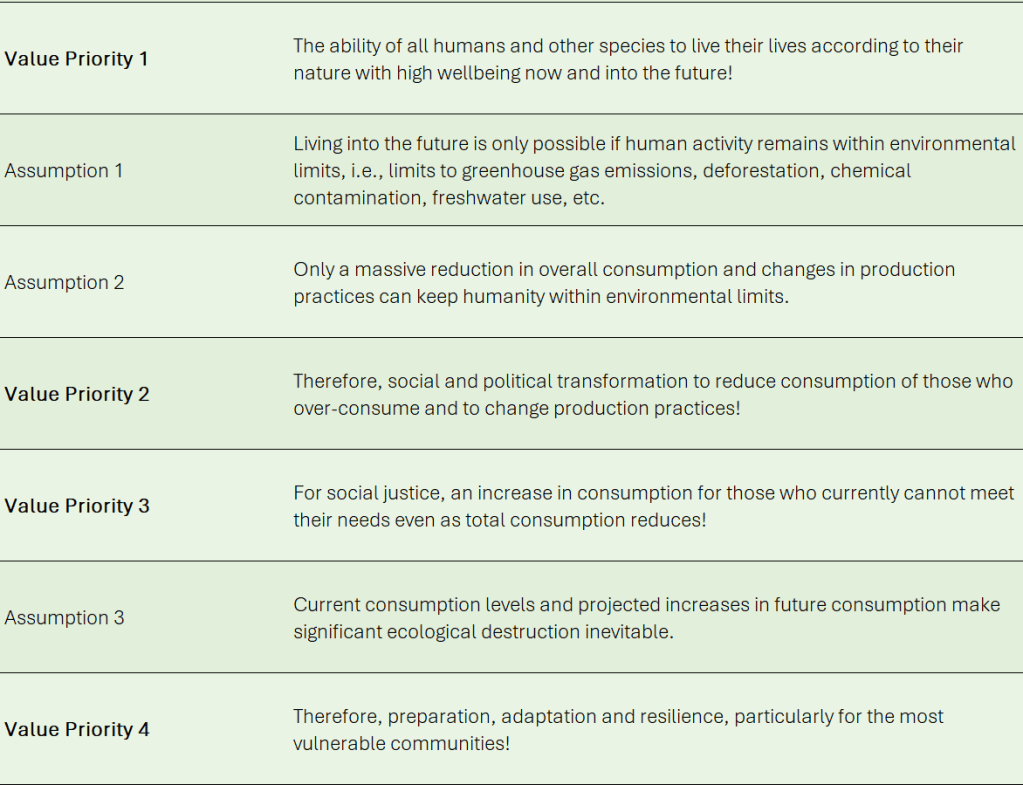
The ecosophy is expressed more formally in Stibbe (2024, p. 22) as follows, where the explanation mark conveys normativity, i.e., that what it follows is to be celebrated, respected or striven for.
Ecosophy in one word: Living!
Further explanation
 The H4rmony Project